Workshop on the Heat and Low-Pressure Table in the Conservation Studio
The conservation studio of The Phoebus Foundation has recently acquired a new addition: a heat and low-pressure table. This significantly expands the range of possibilities within conservation projects, while supporting an approach based on minimal intervention and maximum control.
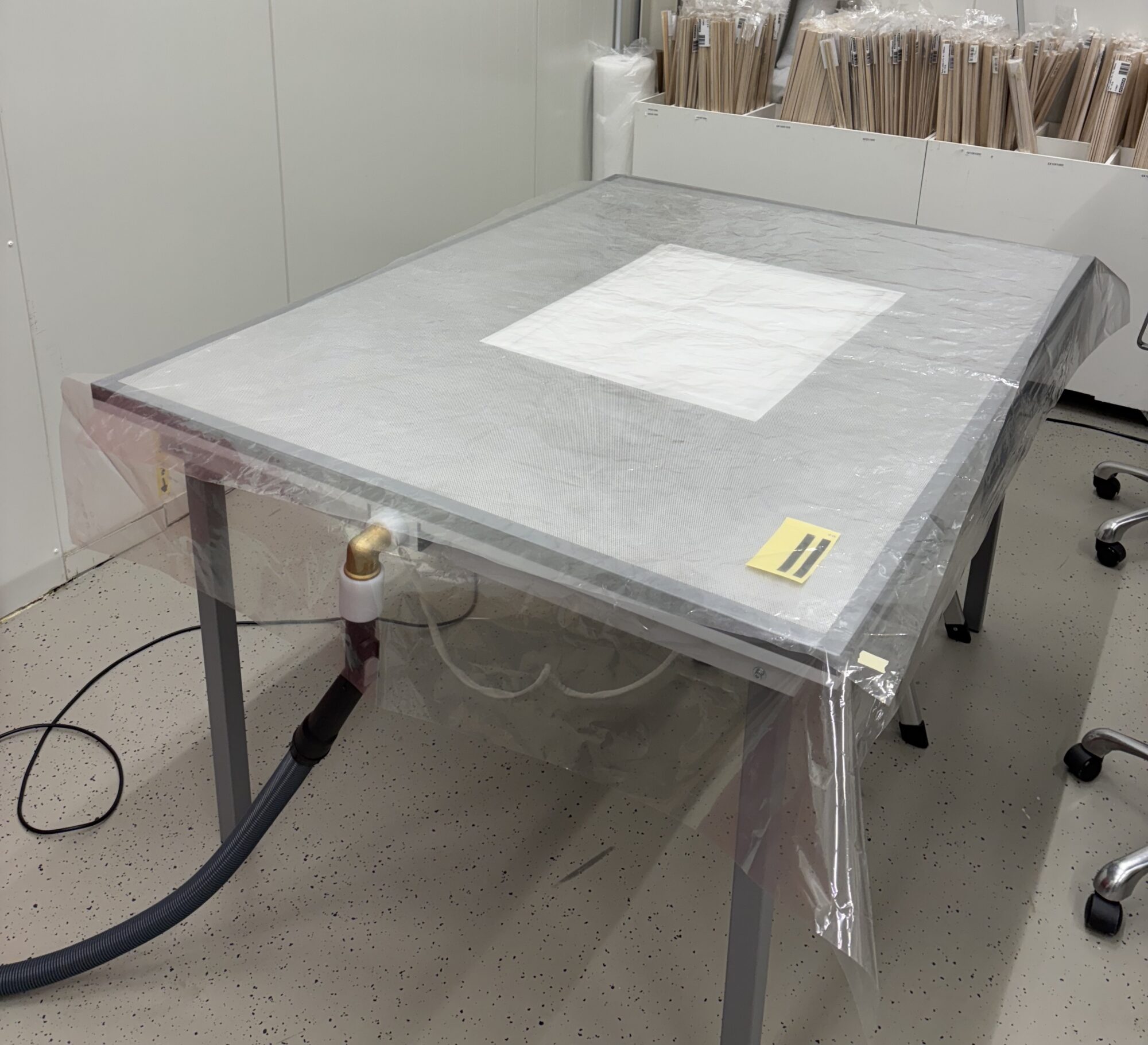
As the conservation team is constantly working on a wide range of treatments, the heat and low-pressure table can play a meaningful role. To explore its use and potential with due care, a workshop was organised, giving conservators insight into its operation, applications, advantages, and points of attention, with a view to its thoughtful use in practice.
For this occasion, Davide Riggiardi travelled from Italy to the conservation studio of The Phoebus Foundation for a three-day workshop, where he shared his expertise on the applications and possibilities of the heat and low-pressure table.
Professor Riggiardi teaches paintings conservation at the Academy of Fine Arts of Palermo and contemporary art conservation at the Academy of Fine Arts of Brera. He is also active as a conservator in his own studio in Milan, where he focuses on preventive conservation and minimal intervention.

The principle behind the table lies in its perforated surface, which allows air to be distributed evenly. When a painting is placed on the table and covered with a layer of Melinex (polyester film), a vacuum pump draws the air out from beneath the object, creating low pressure. The painting is gently pulled downwards, resulting in an even tension across the entire surface, without applying direct pressure to the paint layer. Unlike the use of weights, the intervention remains highly controlled and exceptionally subtle.
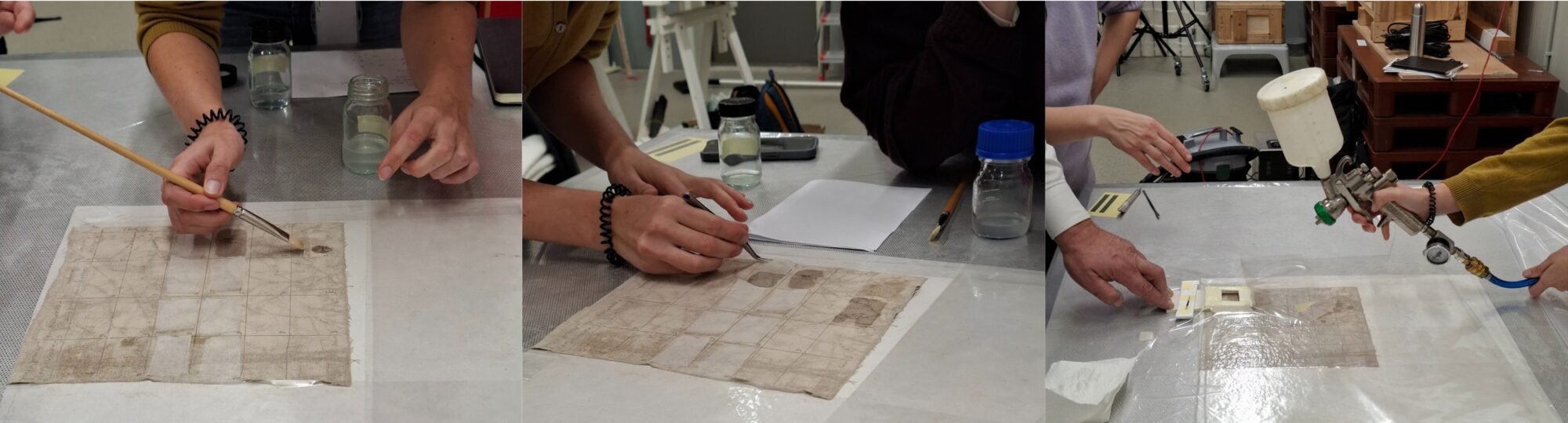
One of the practical sessions involved comparing consolidations carried out on mock-ups, both with and without the use of the low-pressure table. Both mock-ups were distorted and showed the same powdering paint flakes. Seven different adhesives were applied to the surface in various ways: using a brush, a tissue and a spray gun.
Initial observations showed that, in consolidations carried out on the low-pressure table, the solvent evaporated more quickly and penetrated the layers more deeply and evenly. Without low pressure, by contrast, ring formation and distortion occurred, indicating an uneven distribution of adhesive and a less effective consolidation in depth.

In addition to consolidation, the workshop also addressed the execution of edge linings on the heat and low-pressure table. This relatively minimal and, depending on the adhesive used, reversible intervention reinforces weakened canvas edges and enables re-stretching, while the low-pressure function allows for controlled drying without weights and avoids direct pressure on the paint layer. By increasing the temperature, thermoplastic adhesives can also be applied.
The conservators experimented with various adhesives, including Plextol© and BEVA® 371, as well as with different application techniques. The various functions of the table were also tested during the execution of edge linings, both under low pressure and at elevated temperature.

Applying thickened Plextol© using a mosquito net results in a chequerboard pattern. This even distribution ensures stronger and more uniform adhesion between the original canvas and the edge lining.

The edge lining is first positioned on the reverse of the painting. The painting is then turned over and placed under low pressure to dry in a controlled manner. The pressure is generated beneath the painting, while the pictorial layer remains as undisturbed as possible.

These examples represent only a small selection of the applications of the heat and low-pressure table. An entire day was devoted to discussing various case studies drawn from conservation treatments currently underway in The Phoebus Foundation’s conservation studio. The conservators exchanged views with one another and with Professor Davide Riggiardi on questions relating to challenging consolidations and the treatment of supports. Many ideas emerged from these discussions, some of which will soon be put into practice with the greatest possible care for the artworks.